
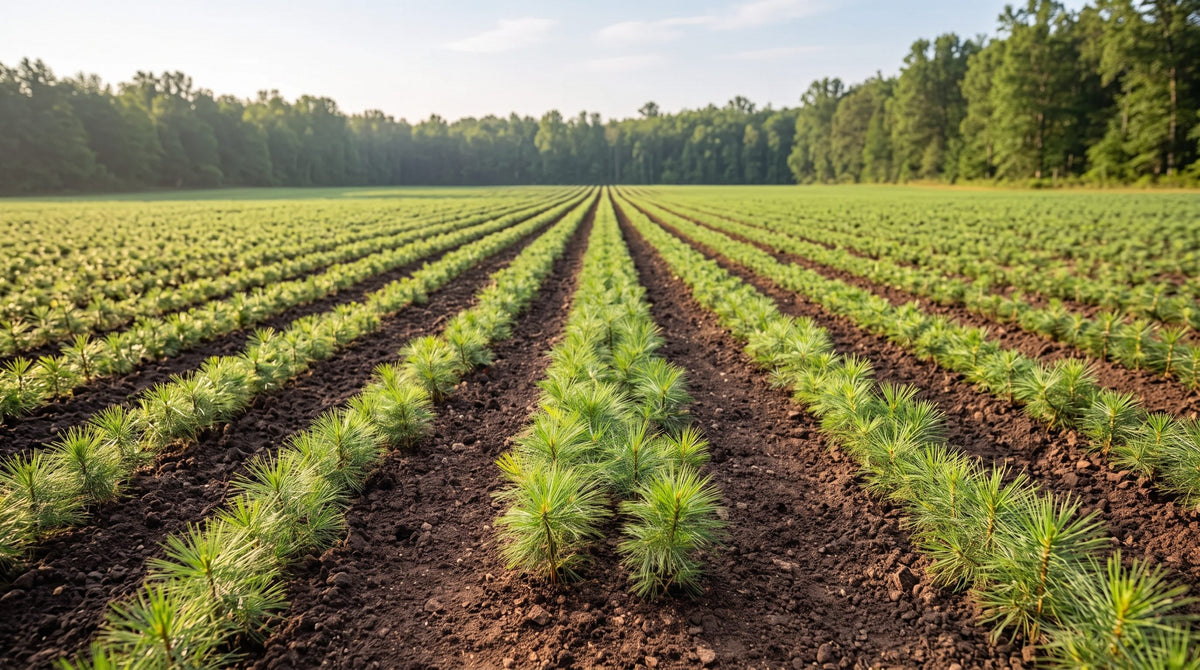
The short answer
How many trees per acre depends on spacing. Divide 43,560, the square feet in an acre, by row spacing times tree spacing in feet. At 10 by 10 feet that is about 435 trees; at 12 by 12, about 302; at 8 by 8, about 680. Then order extra to cover first-season losses, rounded up to full bundles.
Spacing sets the count. Plant trees close together and you fit more on each acre; give them room and you need fewer. Close spacing makes young trees compete for light and grow tall, which suits timber. Wider spacing leaves room for big crowns, nuts and fruit, which suits wildlife and shade. Either way, the number you plant is not the number you should order. Some seedlings will not make it through the first growing season, from drought, browsing deer or a rough planting day. So the useful number is the one you order: your target per acre, plus a cushion for losses, rounded up to the bundle sizes seedlings ship in. This guide walks through that math in five steps. You will find a spacing chart near the end, so you can read off trees per acre for the most common layouts without a calculator.
What you need to plan an order
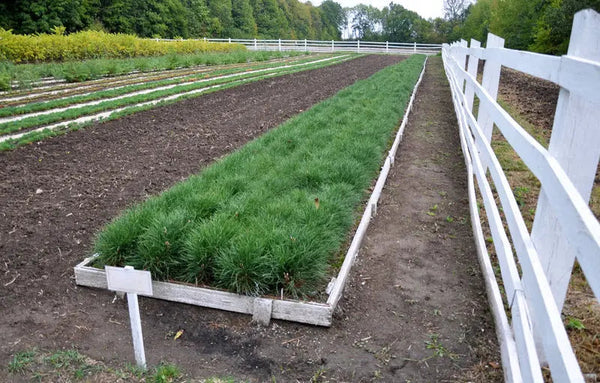
1. Measure the area in square feet
One acre is 43,560 square feet. If your site is a rough rectangle, multiply its length by its width in feet. Divide that by 43,560 to get acres. Leave out anything you will not plant: ponds, rock outcrops, driveways and the strips you keep open for mowing or a firebreak. Measuring the plantable ground, not the deed, keeps you from ordering seedlings you have no room for.
Tip: Walk the boundary with a phone mapping app for a quick area estimate.
2. Choose spacing for your goal
Spacing is two numbers: the distance between rows and the distance between trees in a row. Rows are often set wider so a mower or tractor can pass. Closer spacing fills the site faster and suits timber. Wider spacing gives each tree room to spread, which suits nut, fruit and shade trees. The next section covers goals in more detail.
Tip: Match row width to the widest machine you will run between rows.
3. Divide to get trees per acre
Multiply row spacing by tree spacing to get the square feet each tree takes. Then divide 43,560 by that number. Trees 8 feet apart in rows 10 feet apart take 80 square feet each. So 43,560 ÷ 80 gives about 544 trees per acre. Multiply by your acres for the planting target. On 5 acres at that spacing, the target is about 2,720 trees.
Tip: Round down here; you add the extras in the next step.
4. Add a cushion for first-season losses
Not every seedling lives through its first summer. Drought, deer and late planting all take a share. Decide what share you expect to lose on your site. Then divide your target by the share you expect to keep. For example, if you plan for one in five to fail, keep 0.8: 2,720 ÷ 0.8 gives 3,400 seedlings. Your county forester or extension office can help you judge the right share for your area.
Tip: Planting soon after delivery, with moist roots, protects your cushion.
5. Round up to full bundles
Our maple, oak and pine seedlings ship in bundles of 100, 500 and 1,000. Sizes run 6 to 12 inches, 12 to 18 inches, or row run. Round your order up to full bundles. For 3,400 seedlings, three bundles of 1,000 and one of 500 gives 3,500, with 100 spare for gaps. Mixing species? Split the count first, then round each one. Browse all our seedlings.
Tip: Trial a new species with a single bundle of 100 first.
Spacing by planting goal
Your goal decides where you land on the spacing chart. For timber, trees go in closer so they compete for light and grow tall. The best ones are kept when the stand is thinned later. For wildlife, wider spacing lets more sun reach the ground and gives each tree room for a broad crown. Windbreaks use tight rows, often around 8 by 8 feet, or about 680 trees per acre. Hardwood reforestation is often planted near 12 by 12 feet, about 302 trees per acre. If you want both timber and wildlife, this tree planting guide suggests a middle ground of 500 to 600 seedlings per acre. At 8 by 10 feet you would plant about 544, right inside that range. Mixing species spreads your risk, since one pest or disease rarely hits every kind of tree. The pine and oak seedlings below give you one evergreen and one hardwood to mix.

Care and keeping
Our seedlings ship bare root, so the roots must never dry out. Keep bundles cool and shaded, and plant as soon as you can after they arrive. Carry them in a bucket with moist packing or water while you plant. A seedling whose roots dried in the sun on planting day is one your cushion has to cover.
Frequently asked questions
How do I calculate trees per acre?
Multiply the distance between rows by the distance between trees in a row, both in feet. That gives the square feet each tree uses. Divide 43,560 by it. For a 12 by 12 foot layout, 43,560 ÷ 144 is about 302 trees per acre. Multiply by your acres for the total.
What is the 10/20/30 rule for trees?
It is an urban forestry guideline for tree diversity: no more than 10% of trees from one species, 20% from one genus and 30% from one family. It aims to limit losses when a pest or disease strikes. It was written for city trees, but it is a useful check when you mix species on an acre.
What spacing gives 200 trees per acre?
Divide 43,560 by 200 to get about 218 square feet per tree. A 14 by 15 foot layout gives about 207 trees per acre, and 15 by 15 feet gives about 193. Choose the one that fits your mower or tractor, then add your loss cushion before ordering.
Trees per acre spacing chart
Read across for the square feet each tree uses, the trees per acre, and a common use for that spacing. The last column shows how many to order for one acre if, as an example, you plan for one in five seedlings to fail. Multiply by your acres, then round up to full bundles.
| Spacing (feet) | Square feet per tree | Trees per acre | Common use | Order per acre (example: 1 in 5 lost) |
|---|---|---|---|---|
| 6 × 6 | 36 | 1,210 | Dense block planting | 1,513 |
| 6 × 10 | 60 | 726 | Close rows with room to mow | 908 |
| 8 × 8 | 64 | 680 | Windbreaks | 850 |
| 8 × 10 | 80 | 544 | Timber and wildlife mix | 680 |
| 10 × 10 | 100 | 435 | General planting | 544 |
| 10 × 12 | 120 | 363 | General planting, wider rows | 454 |
| 12 × 12 | 144 | 302 | Hardwood reforestation | 378 |
| 15 × 15 | 225 | 193 | Semi-dwarf fruit trees | 242 |
| 20 × 20 | 400 | 108 | Standard orchards | 135 |
| 30 × 30 | 900 | 48 | Full-size fruit or walnut timber | 60 |
Square feet per tree
- 6 × 6
- 36
- 6 × 10
- 60
- 8 × 8
- 64
- 8 × 10
- 80
- 10 × 10
- 100
- 10 × 12
- 120
- 12 × 12
- 144
- 15 × 15
- 225
- 20 × 20
- 400
- 30 × 30
- 900
Trees per acre
- 6 × 6
- 1,210
- 6 × 10
- 726
- 8 × 8
- 680
- 8 × 10
- 544
- 10 × 10
- 435
- 10 × 12
- 363
- 12 × 12
- 302
- 15 × 15
- 193
- 20 × 20
- 108
- 30 × 30
- 48
Common use
- 6 × 6
- Dense block planting
- 6 × 10
- Close rows with room to mow
- 8 × 8
- Windbreaks
- 8 × 10
- Timber and wildlife mix
- 10 × 10
- General planting
- 10 × 12
- General planting, wider rows
- 12 × 12
- Hardwood reforestation
- 15 × 15
- Semi-dwarf fruit trees
- 20 × 20
- Standard orchards
- 30 × 30
- Full-size fruit or walnut timber
Order per acre (example: 1 in 5 lost)
- 6 × 6
- 1,513
- 6 × 10
- 908
- 8 × 8
- 850
- 8 × 10
- 680
- 10 × 10
- 544
- 10 × 12
- 454
- 12 × 12
- 378
- 15 × 15
- 242
- 20 × 20
- 135
- 30 × 30
- 60