
The short answer
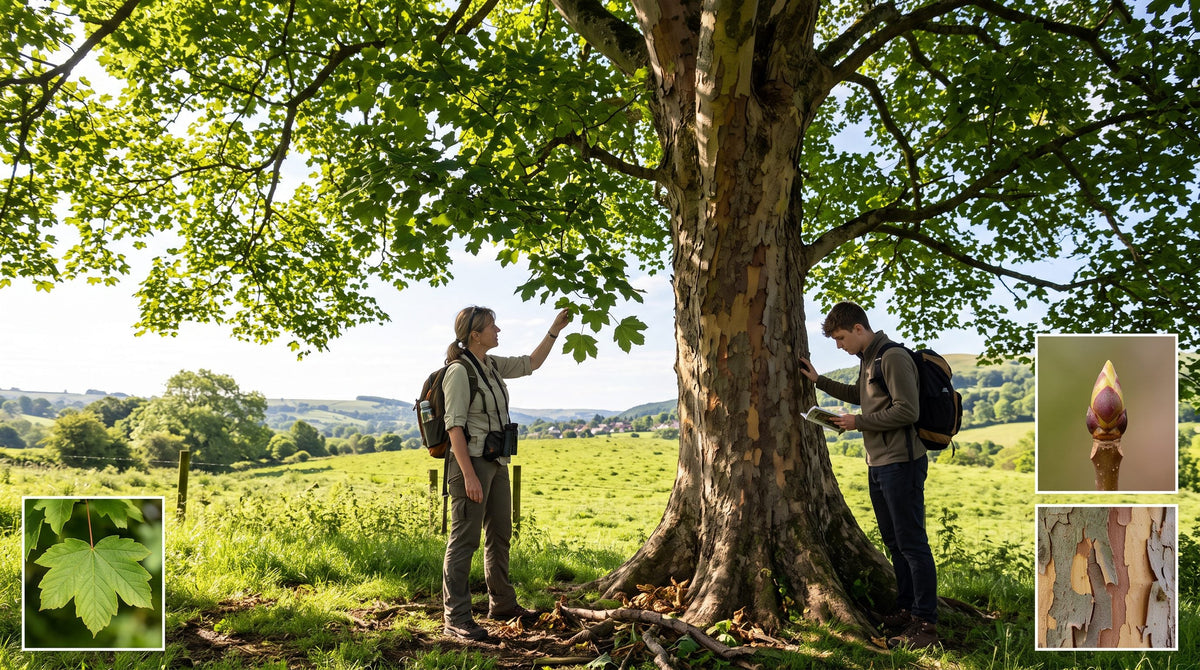
Sycamore tree identification starts with the bark: American sycamore sheds it in flat pieces, leaving cream, gray and olive patches and bright white upper limbs. Then check for large alternate leaves with 3 to 5 lobes, a bud hidden inside the leaf-stem base, and one round seed ball hanging from each long stalk.
The name sycamore covers more than one tree, which is why so many people get it wrong. In the US, sycamore means American sycamore, Platanus occidentalis, a native plane tree. In Britain, sycamore means sycamore maple, Acer pseudoplatanus, a true maple. Parks and city streets add a third tree, the London plane, a hybrid that looks almost the same as our native one. This guide walks through four checks. Bark and seed balls work all year, while leaves and the hidden bud work best from spring to fall. Together they separate American sycamore from its look-alikes, and the table at the end puts them side by side. The native range runs from Iowa to Ontario and New Hampshire, and south to Texas and Florida. Sycamores like wet ground and do well beside streams and ponds, so start your search near water. If you plan to plant one, the care note near the end covers the site it needs.
Sycamore tree identification: trees to know


1. Check the bark for white patches
Sycamore bark is stiff and does not stretch. As the trunk grows, the bark breaks off in large, flat pieces. That leaves a patchwork of cream, gray and olive, often called camouflage bark. Look higher up the tree too. The upper trunk and limbs are smooth and bright white, which stands out from far away. On old trees, the base of the trunk can turn brown and scaly.
Tip: River birch also peels, but in thin, curling salmon-to-rust sheets, not flat patches.
2. Look at leaf shape and arrangement
Sycamore leaves are big, 4 to 9 inches long, with 3 to 5 shallow lobes and coarse teeth. They look like maple leaves, which is where many mix-ups start. The fix is to check how they sit on the twig. Sycamore leaves are alternate: one leaf at each point, staggered along the stem. Maple leaves are opposite, in pairs. New sycamore leaves and twigs carry fine, pale hairs, and the underside stays soft and whitish.
Tip: A twig with leaves in opposite pairs is a maple, not a sycamore.
3. Pull a leaf to find the hidden bud
This is the check that settles it. Gently pull a leaf off a sycamore twig in summer. The base of the leaf stem is swollen and hollow, like a little cap. Underneath sits the next year's bud, completely hidden while the leaf is on. Maples show their buds in plain sight beside the leaf stem. In winter, look at the twigs instead: they zigzag, with a cone-shaped, reddish-brown bud at each bend.
4. Count the seed balls on each stalk
From fall through winter, sycamores hang round, fuzzy seed balls, about 1 to 1.5 inches across, on long stalks. They often stay on the tree all winter, so they are a handy clue when the leaves are gone. An American sycamore carries one ball per stalk. The London plane has two or even three on a single stalk. In spring the balls break apart, and each seed floats off on fine hairs.
Tip: Pair this with the white upper bark and you can name a sycamore from the road.
Sycamore vs London plane and maples
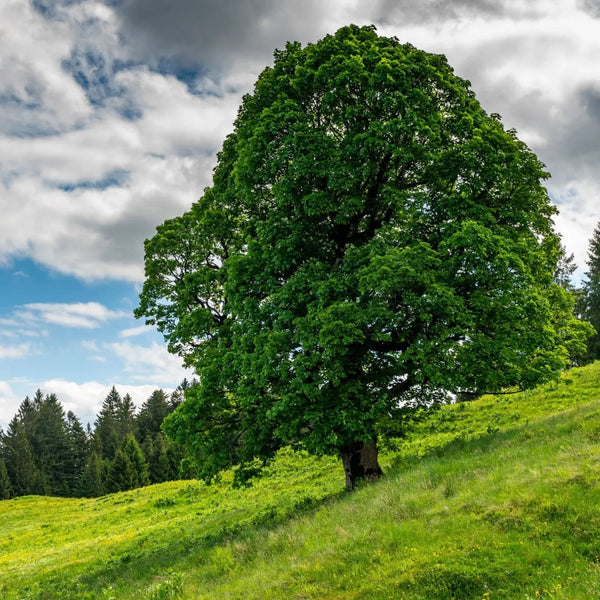
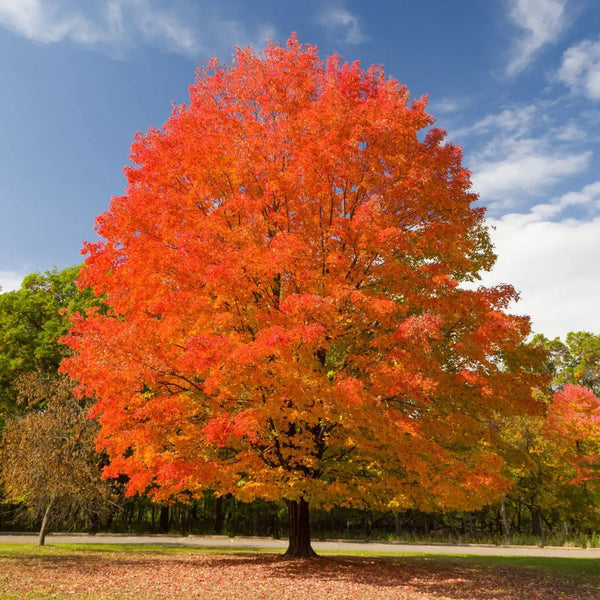
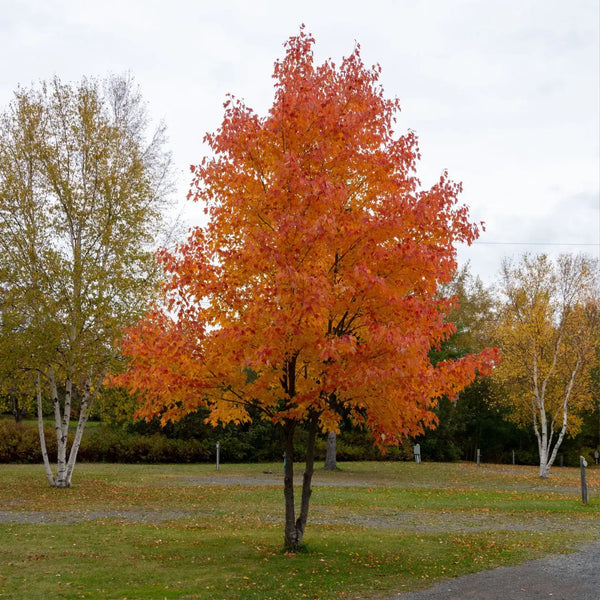
Is a sycamore the same as a maple? No. American sycamore is a plane tree, from the genus Platanus, while maples belong to Acer. The leaves look alike, but sycamore leaves are alternate and maple leaves grow in opposite pairs. Maples also drop paired winged seeds, not seed balls. The sycamore maple, Acer pseudoplatanus, is the tree British guides call sycamore. It is a true maple, with opposite five-lobed leaves and winged seeds, so it fails both the leaf check and the seed check. The London plane is trickier. It is a hybrid plane tree planted along city streets, and its bark peels in the same patchy way. Look for two or three seed balls per stalk, and expect it in parks and paved areas more than on a creek bank. If you are weighing a sycamore against a native maple for a site, sugar maple and silver maple are two to consider. Sugar maple wants deep, well-drained loam, while silver maple and sycamore both handle wet ground.
Care and keeping
Plant American sycamore where it has room. It grows fast and wide, with a broad, branching root system, so give it open ground away from buildings. It suits zones 4 to 9, full sun, and clay, sand or loam. Wet ground, stream banks, ponds and floodplains suit it best.
Frequently asked questions
How can I identify sycamore tree leaves?
Look for a large leaf, 4 to 9 inches long, with 3 to 5 shallow, toothed lobes. It sits alternate on the twig, not in pairs. Pull one off: if the stem base is a hollow cap hiding a bud, it is a sycamore or a plane-tree cousin. Young leaves feel fuzzy, with a pale underside.
How do you identify a sycamore in winter?
Winter makes it easy. Look for bright white upper limbs that show from far off, and patchy cream, gray and olive bark lower down. Round seed balls hang one per stalk, often right through the winter. Up close, the twigs zigzag, with a cone-shaped bud at each bend.
What are the uses of the American sycamore tree?
It is planted for shade on large properties and along stream banks, wetlands and floodplains, where wet soil stops other hardwoods. Hollow old trunks shelter bats, wood ducks, owls and chimney swifts. The heavy wood has gone into butcher blocks, crates, furniture and musical instruments.
Sycamore look-alike comparison table
| Tree | Leaves | Buds | Seeds | Bark |
|---|---|---|---|---|
| American sycamore | Alternate, 3 to 5 shallow lobes, 4 to 9 inches | Hidden under the leaf-stem base | One ball per stalk | Cream, gray and olive patches; white upper limbs |
| London plane | Alternate, lobed, much like sycamore | Hidden under the leaf-stem base | Two or three balls per stalk | Peels in patches, like sycamore |
| Sycamore maple | Opposite, five lobes | Beside the leaf stem | Paired winged seeds | No white patchwork |
| Sugar maple | Opposite, five lobes, rounded notches | Beside the leaf stem | Paired winged seeds | No white patchwork |
| Silver maple | Opposite, angular notches | Beside the leaf stem | Paired wings, 1 to 3 inches, drop late spring into summer | No white patchwork |
Leaves
- American sycamore
- Alternate, 3 to 5 shallow lobes, 4 to 9 inches
- London plane
- Alternate, lobed, much like sycamore
- Sycamore maple
- Opposite, five lobes
- Sugar maple
- Opposite, five lobes, rounded notches
- Silver maple
- Opposite, angular notches
Buds
- American sycamore
- Hidden under the leaf-stem base
- London plane
- Hidden under the leaf-stem base
- Sycamore maple
- Beside the leaf stem
- Sugar maple
- Beside the leaf stem
- Silver maple
- Beside the leaf stem
Seeds
- American sycamore
- One ball per stalk
- London plane
- Two or three balls per stalk
- Sycamore maple
- Paired winged seeds
- Sugar maple
- Paired winged seeds
- Silver maple
- Paired wings, 1 to 3 inches, drop late spring into summer
Bark
- American sycamore
- Cream, gray and olive patches; white upper limbs
- London plane
- Peels in patches, like sycamore
- Sycamore maple
- No white patchwork
- Sugar maple
- No white patchwork
- Silver maple
- No white patchwork