
The short answer
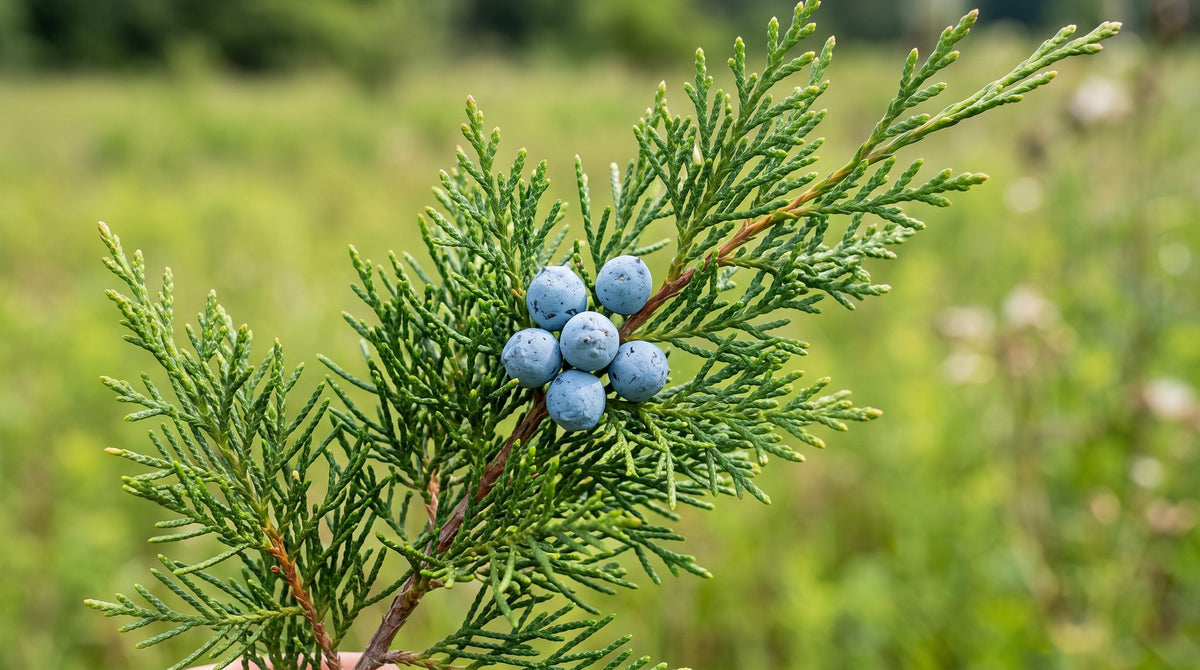
Cedar tree identification starts with the leaves and cones. True cedars (Cedrus) carry stiff needles in tufts on short spurs and upright, barrel-shaped cones. Most American "cedars" are not true cedars. Eastern red cedar is a juniper with dusty blue, berry-like cones. Northern white and western red cedars are arborvitae, with flat, scaly sprays.
The word cedar covers a lot of trees in the United States, and most of them are not cedars at all. True cedars belong to the genus Cedrus, a small group from the mountains of North Africa, the Middle East and the Himalayas. Here they are planted as ornamental trees. The native trees that carry the name belong to other groups. Eastern red cedar is a juniper. Northern white cedar and western red cedar are arborvitae, the same group as many privacy hedges. This guide names each one plainly and walks you through five checks: leaves, cones, sprays, bark and shape. You can do all of them in a few minutes with a branch in your hand. We grow eastern red cedar for windbreaks, screens, fence lines and wildlife cover, so you will also find notes on where it thrives and where it causes trouble for apple growers. Start with the leaves.
Cedar tree identification in five checks

1. Check the leaves: needle tufts or flat scales
Pull a branch close and look at how the leaves grow. A true cedar has stiff needles about 1 to 2 inches long, packed in tufts on short woody spurs along the twig. Eastern red cedar, northern white cedar and western red cedar have tiny scale leaves that hug the twig instead. Young red cedars can also show short, sharp needle-like leaves, so check older growth too.
Tip: A tuft of needles on a spur means Cedrus. Scales mean a juniper or arborvitae.
2. Look for upright barrels or blue berries
Cones settle most arguments. True cedars hold barrel-shaped cones upright on top of the branches, and the cones break apart on the tree when ripe. Female eastern red cedars carry dusty blue, berry-like cones coated in white wax that take 6 to 8 months to ripen. Most trees are male or female, so a red cedar with no berries may simply be a male.
Tip: Cedar waxwings love the blue cones, so a busy flock often points to a female red cedar.
3. See how the leaf sprays lie
On the scale-leaved cedars, look at the shape of each branch tip. Northern white cedar and western red cedar grow their scales in flat, fan-like sprays, as if pressed in a book. Eastern red cedar's sprays are rounder and bushier, branching in every direction. Where you stand helps too: western red cedar grows wild in the Pacific Northwest, and northern white cedar in the Northeast and Great Lakes.
Tip: Flat fans point to arborvitae (Thuja). Round, bushy sprays point to juniper.
4. Feel the bark and smell the wood
Bark helps on older trunks. True cedars have dark gray to brown bark that becomes deeply furrowed with age. Eastern red cedar has reddish-brown bark that peels in thin, stringy strips. Then use your nose. Red cedar heartwood is fragrant, which is why it lines cedar chests and closets, and moths avoid it. It also resists rot, even in the ground, so it has long been used for fence posts.
Tip: A fresh-cut stump shows the red heartwood that gives eastern red cedar its name.
5. Tell Atlas, deodar and Lebanon cedars apart
If the tree has needle tufts and upright cones, it is a true cedar, and the shape tells you which. Atlas cedar has short needles, often silvery blue, with branch tips that point upward. Deodar cedar has softer, longer needles and branch tips that droop gracefully. Cedar of Lebanon grows wide, with flat, layered branches. These three are the true cedars you are most likely to meet in American parks and yards.
Tip: Blue Atlas cedar is a blue-needled form of Atlas cedar.
Cedar lookalikes: arborvitae and cypress
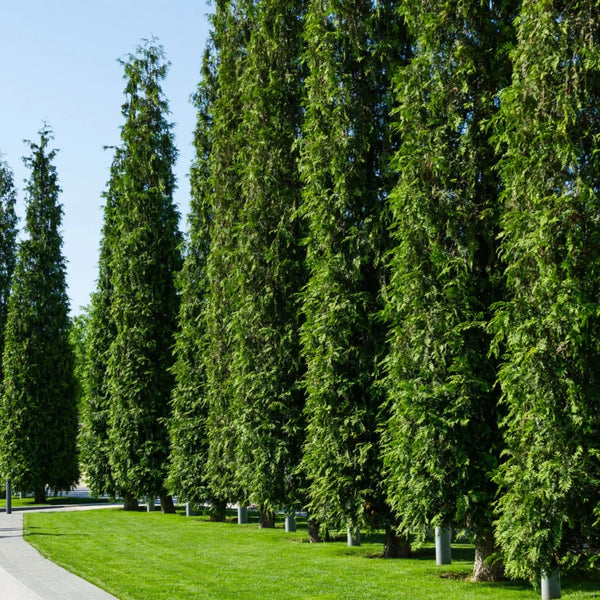
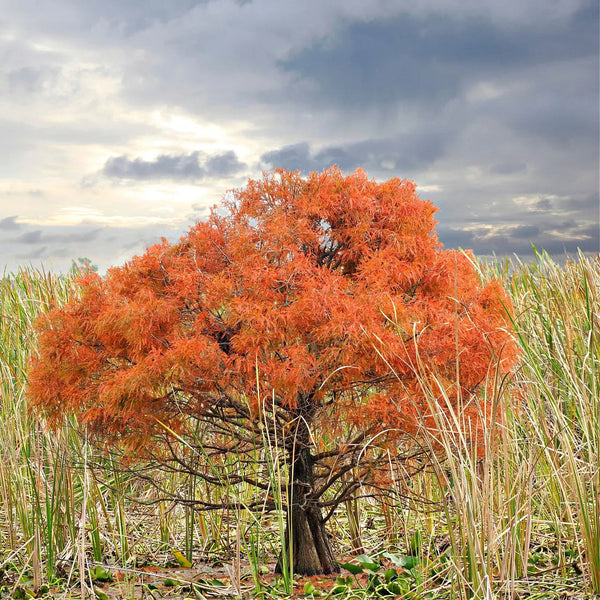
Northern white cedar is an arborvitae, Thuja occidentalis. To spot one, look for flat, fan-like sprays of scale leaves, with no needle tufts and no blue berries. Western red cedar, Thuja plicata, is its larger cousin from the Pacific Northwest, and it can grow into a huge forest tree. Both share their genus with Green Giant arborvitae, a fast-growing Thuja we sell for quick privacy screens. Cypress is the other common mix-up. Bald cypress looks feathery and soft, but its needles are under an inch long and the whole tree sheds them every autumn. Before they drop, they turn yellow, then a rusty copper-red. No cedar does that. In wet ground, bald cypress also pushes up woody knees from its roots. So if a conifer stands bare in winter, it is not a cedar. A cedar, true or false, stays green all year, which is why our red cedars make dependable winter windbreaks.
Care and keeping
Plant eastern red cedar in full sun. It is hardy in zones 2 to 9 and handles drought and rocky, sandy or clay soil. Cedar-apple rust needs both a red cedar and an apple to finish its life cycle, and the apples suffer. Set cedars on the far side of the property from home orchards.
Frequently asked questions
What type of tree is a cedar tree?
A true cedar is a conifer in the genus Cedrus, part of the pine family. It is an evergreen with needle tufts and upright, barrel-shaped cones. In North America, the name also covers native junipers and arborvitae, such as eastern red cedar and northern white cedar, which are in the cypress family.
How do you identify white cedar trees?
Northern white cedar has flat, fan-like sprays of tiny scale leaves rather than needles. It has no blue berries, which rules out eastern red cedar, and no needle tufts or barrel cones, which rules out true cedars. Its genus is Thuja, the same as arborvitae hedges such as Green Giant.
What are the key differences between true cedars and false cedars?
True cedars (Cedrus) have needles in tufts on short spurs and upright cones that break apart on the branch. False cedars, such as junipers and arborvitae, have scale leaves in sprays. Their cones are small, or berry-like and blue in eastern red cedar. True cedars are planted ornamentals in the US; false cedars include the natives.
True vs false cedar at a glance
| Tree | Group | Leaves | Cones | Bark |
|---|---|---|---|---|
| Atlas, deodar and Lebanon cedar | True cedar (Cedrus) | Stiff needles in tufts on short spurs | Upright barrels that break apart on the tree | Dark gray to brown, deeply furrowed |
| Eastern red cedar | Juniper (Juniperus virginiana) | Scale leaves in round, bushy sprays | Dusty blue, waxy berry-like cones on female trees | Reddish-brown, peels in thin strips |
| Northern white cedar | Arborvitae (Thuja occidentalis) | Scale leaves in flat fans | Small and dry, never blue or waxy | Not a reliable clue: use the flat sprays |
| Western red cedar | Arborvitae (Thuja plicata) | Scale leaves in flat fans | Small and dry, never blue or waxy | Not a reliable clue: use the flat sprays and range |
| Bald cypress | Cypress family (Taxodium distichum) | Soft needles under an inch, shed every fall | Start green, finish brown | Flared base on wet ground |
Group
- Atlas, deodar and Lebanon cedar
- True cedar (Cedrus)
- Eastern red cedar
- Juniper (Juniperus virginiana)
- Northern white cedar
- Arborvitae (Thuja occidentalis)
- Western red cedar
- Arborvitae (Thuja plicata)
- Bald cypress
- Cypress family (Taxodium distichum)
Leaves
- Atlas, deodar and Lebanon cedar
- Stiff needles in tufts on short spurs
- Eastern red cedar
- Scale leaves in round, bushy sprays
- Northern white cedar
- Scale leaves in flat fans
- Western red cedar
- Scale leaves in flat fans
- Bald cypress
- Soft needles under an inch, shed every fall
Cones
- Atlas, deodar and Lebanon cedar
- Upright barrels that break apart on the tree
- Eastern red cedar
- Dusty blue, waxy berry-like cones on female trees
- Northern white cedar
- Small and dry, never blue or waxy
- Western red cedar
- Small and dry, never blue or waxy
- Bald cypress
- Start green, finish brown
Bark
- Atlas, deodar and Lebanon cedar
- Dark gray to brown, deeply furrowed
- Eastern red cedar
- Reddish-brown, peels in thin strips
- Northern white cedar
- Not a reliable clue: use the flat sprays
- Western red cedar
- Not a reliable clue: use the flat sprays and range
- Bald cypress
- Flared base on wet ground
