
The short answer
Honey locust vs black locust comes down to leaves and thorns. Honey locust has small, fern-like leaflets and single, branched thorns. Black locust has larger oval leaflets and short thorns in pairs, a clue that works even on leafless young trees. Plant honey locust for light shade on tough ground; black locust for poor soil and posts.
Honey locust vs black locust compared
| Feature | Honey locust | Black locust |
|---|---|---|
| Leaflets | Small, fine, fern-like; often doubly divided | Larger, rounded oval, once divided |
| Thorns | Branched, 2 to 3 inches, on trunk | Short, paired, at leaf bases |
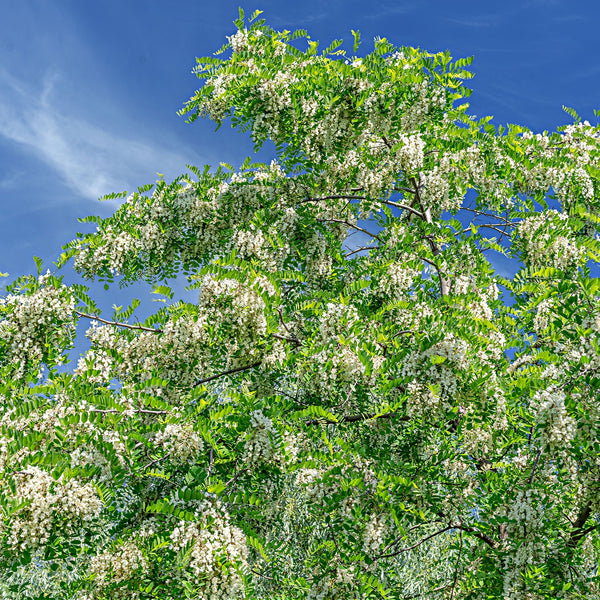
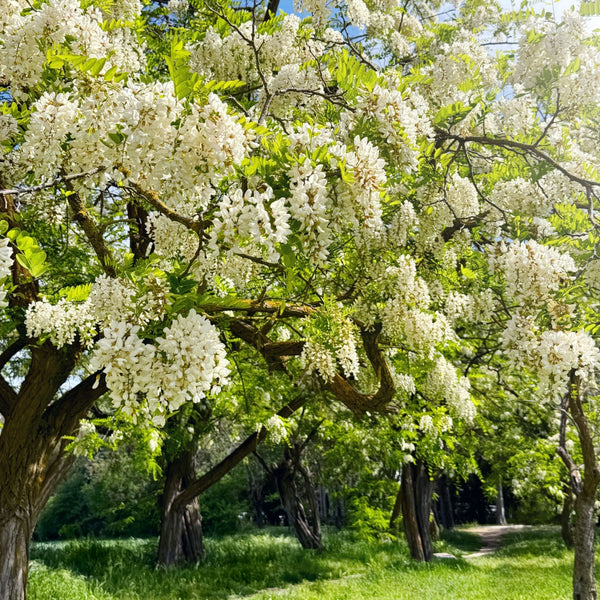
| Flowers | Small, greenish-yellow, late spring | Hanging white clusters, late spring |
| Pods | 12 to 18 inches, twisted, red-brown | 2 to 4 inches, flat, brown |
| Bark | Flatter, in long plates | Gray, deeply furrowed, rope-like |
| Hardiness zones | 4 to 9 | 3 to 9 |
Honey locust
- Leaflets
- Small, fine, fern-like; often doubly divided
- Thorns
- Branched, 2 to 3 inches, on trunk
- Flowers
- Small, greenish-yellow, late spring
- Pods
- 12 to 18 inches, twisted, red-brown
- Bark
- Flatter, in long plates
- Hardiness zones
- 4 to 9
Black locust
- Leaflets
- Larger, rounded oval, once divided
- Thorns
- Short, paired, at leaf bases
- Flowers
- Hanging white clusters, late spring
- Pods
- 2 to 4 inches, flat, brown
- Bark
- Gray, deeply furrowed, rope-like
- Hardiness zones
- 3 to 9
Choose honey locust if
- You want light, dappled shade that lets the lawn keep growing below the tree.
- Your site has compacted soil, road salt, drought, wind or spells of wet ground.
- You can plant it on open ground, away from paths, where its thorns will not bother anyone.
Choose black locust if
- You are planting poor, dry or eroded ground where other trees struggle.
- You want a windbreak, or a woodlot for fence posts, stakes and firewood.
- You keep bees and want white spring flowers that bees work hard.
Telling seedlings apart
On a leafless young tree, check the thorns first. Short spines in pairs near each leaf scar (the mark a fallen leaf leaves) mean black locust; single, stout thorns mean honey locust. That matters because our bare-root trees ship dormant in November, with no leaves at all. Once leaves open, look at their shape. Both trees have compound leaves, meaning one stalk lined with many small leaflets. Black locust carries roughly 7 to 19 rounded oval leaflets on each stalk. They are often blue-green, with a small notch at the tip. Honey locust looks finer and more fern-like. Its leaflets are smaller, and many leaves are doubly divided, with side stalks that each carry their own row of leaflets. As honey locust grows, its single thorns fork into branched spikes, while black locust thorns stay short.
Which to plant where
For shade, pick honey locust. Its fine leaves let dappled light reach the lawn, and it grows quickly in full sun. It shrugs off clay, sand, compacted soil, drought, road salt and wind. The species we supply is thorny, so plant it on open ground, away from paths and play areas. For erosion and poor ground, pick black locust. It fixes its own nitrogen, which feeds the soil around it, and it grows on thin, dry or eroded ground. Plant it on slopes, field edges, old pasture and reclaimed sites, but not where water sits. For fence posts, black locust wins, since its heartwood barely rots. For wildlife, both help: bees visit both trees' flowers, and deer, squirrels and rabbits eat honey locust pods. Black locust spreads by root suckers and is listed as invasive in parts of the Midwest, so check local guidance first.
Our verdict
Choose honey locust for fast, light shade on tough, open sites, as long as its thorns sit away from foot traffic. Choose black locust for poor or eroded ground, windbreaks, bee forage and long-lasting fence posts.
Frequently asked questions
- Is honey locust poisonous?
NC State Extension lists honey locust as non-toxic to cats, dogs and horses, and the pulp inside its pods is edible and sweet. Black locust is different. Poison Control says its bark, seeds and leaves contain toxins that can harm livestock and people, so keep animals from chewing them.
- Is there a thornless honey locust?
Yes. A thornless form, Gleditsia triacanthos var. inermis, is available, along with named varieties such as 'Sunburst'. The honey locust we supply is the thorny species, with large branched thorns on the trunk and limbs. Plant it where people and pets will not brush against the trunk.