
The short answer
Pine tree identification starts with one bundle of needles. Pull a cluster and count the needles held together by a papery sheath at the base. In the eastern US, five means white pine. Two points to Virginia or shortleaf pine. Three points to loblolly, pitch or longleaf pine. Then use needle length, cones and bark to settle it.
Pines are the easiest evergreens to sort once you know where to look. Every true pine holds its needles in small bundles, and the number in each bundle stays fairly steady within a species. That makes needle count the quickest first check, ahead of bark or cones. This key covers the pines you are most likely to meet in the eastern and southern United States: eastern white, Virginia, shortleaf, loblolly, pitch, longleaf and slash pine. We grow white, Virginia and loblolly pine seedlings for landscape and reforestation projects, so those three get the closest look. You need only a few minutes, a fallen bundle or a low branch, and a ruler or tape measure. Work through the five steps in order, then check your answer against the chart at the end. Once you know which pine you have, the planting section helps you pick the right one for your own ground.
Pine tree identification, step by step

1. Check for bundles: pine, spruce or fir
Look at where the needles join the twig. A pine holds its needles in bundles of two, three or five, wrapped at the base by a thin papery sheath. Spruce needles grow one at a time from small woody pegs, so a bare twig feels rough. Fir needles also grow singly, but they are soft and flat and leave a smooth twig. See Ohio State's guide to pine, spruce and fir for more.
Tip: Fir cones stand upright and break apart on the tree, so whole fir cones rarely lie on the ground.
2. Count the needles in one bundle
Pick a healthy bundle from a low branch or the ground below. Pinch the papery sheath and gently fan the needles apart. Count them, then check two or three more bundles, since a few species sometimes carry an extra or one fewer. Five needles sends you to step three. Two sends you to step four, and three to step five.
Tip: Loblolly and shortleaf can mix two- and three-needle bundles, so count several before you decide.
3. Five needles: eastern white pine
In the eastern US, a five-needle bundle almost always means eastern white pine. The needles are soft, bendy and blue-green, about 3 to 5 inches long. The cones are long and narrow, up to 8 inches, and sticky with resin. Young bark is smooth and greenish, then darkens and breaks into ridges with age. Trees usually start bearing cones between 5 and 10 years old.
Tip: No cones yet? Needle count and soft blue-green color are enough on a young tree.
4. Two needles: Virginia or shortleaf pine
Among the southern pines, two needles usually points to Virginia or shortleaf pine. Virginia pine needles are short, 1.5 to 3 inches, strongly twisted and yellow-green. Its small cones carry prickly tips on the scales, and the bark is dark brown with shallow cracks. Shortleaf needles are longer, 2.5 to 4.5 inches, and its reddish-brown bark forms puzzle-like plates. Slash pine can also carry two. Clemson Extension's southern pine guide compares all three.
Tip: Roll a Virginia pine bundle between your fingers: the twist is easy to feel.
5. Three needles: loblolly, pitch or longleaf
With three needles, length does most of the sorting. Loblolly needles are long, 6 to 10 inches, and dark yellow-green. Its bark starts scaly and reddish gray-brown, then forms large flat red-brown plates. Pitch pine needles are shorter and very stiff, 3 to 5 inches. Longleaf needles are the longest, 8 to 12 inches. Slash pine can carry two or three needles, 4 to 10 inches.
Tip: Where lengths overlap, check the cones: longleaf cones are tapered and slightly curved.
Which pine to plant for your site
Once you can name a pine, the next step is matching one to your ground. Eastern white pine suits the cooler end of the range, zones 3 to 8. It wants full sun or light shade and moist, well-drained, acidic soil. Keep it away from road salt, alkaline soil and standing water. Loblolly pine is the fastest-growing southern pine and is hardy in zones 6 to 9. It needs six or more hours of sun and copes with wet, poorly drained sites better than most pines. Virginia pine is the tough choice for heavy ground. It is highly tolerant of clay, adapts to many soils, and grows into a dense, conical tree. Its pyramid shape suits home-grown Christmas trees. For a head start, our Virginia pine trees come in larger 1 to 4 foot sizes. For screens or reforestation, all three species come as seedlings in our wholesale seedling collection.

Care and keeping
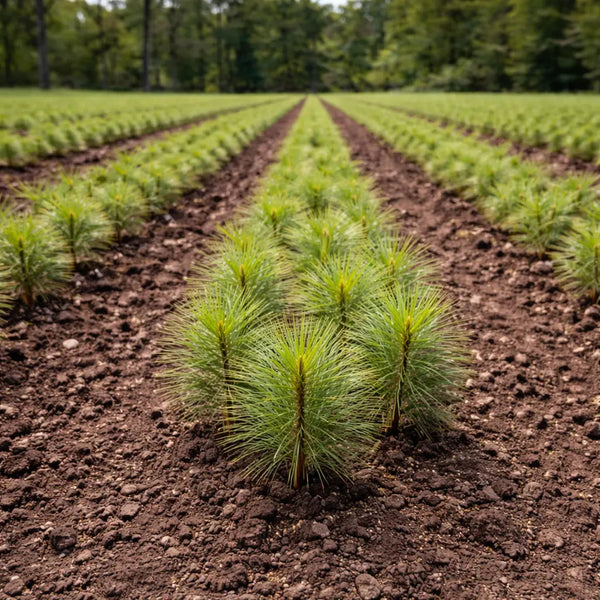
Pine roots hate drying out. Keep the bundle's roots wet and shaded until planting day. Dig a hole deep enough for the roots to hang straight down. Set each seedling at the depth it grew, with the root collar (where stem meets root) just below the surface. Firm the soil, water it in and mulch to hold moisture.
Frequently asked questions
What tree looks like a pine tree but isn't?
Spruce and fir are the usual lookalikes. Both carry single needles instead of bundles. Spruce needles are stiff and four-sided, and they sit on woody pegs that leave twigs rough. Fir needles are soft and flat, smell citrusy when crushed, and leave a smooth twig. Fir cones stand upright on the branch.
How do you identify a pine tree by its needles?
Count the needles in one bundle, held together by a papery sheath at the base. In the East and South, five needles means eastern white pine. Two usually means Virginia or shortleaf pine. Three usually means loblolly, pitch or longleaf. Then measure the needles: length separates pines with the same count.
How do you plant a pine tree?
Plant bare-root pine seedlings soon after they arrive, and keep the roots damp until then. Open a hole deep enough for the roots to hang straight, set the root collar just below the surface, and pack the soil firmly to remove air pockets. On heavy clay or wet ground, plant on a slight mound.
Pine tree identification chart for eastern and southern pines
| Pine | Needles per bundle | Needle length | Cones | Bark |
|---|---|---|---|---|
| Eastern white pine | 5 | 3 to 5 in, soft, blue-green | Long and narrow, up to 8 in, resiny | Smooth and greenish when young, ridged later |
| Virginia pine | 2 | 1.5 to 3 in, strongly twisted, yellow-green | 1.5 to 3 in, prickly scales | Dark brown, shallow cracks |
| Shortleaf pine | 2, sometimes 3 | 2.5 to 4.5 in | 1.5 to 2.5 in, stay on for years | Reddish-brown plates with resin pockets |
| Loblolly pine | 3, sometimes 2 | 6 to 10 in, dark yellow-green | 3 to 6 in | Scaly when young, flat red-brown plates later |
| Pitch pine | 3 | 3 to 5 in, very stiff | Egg-shaped, often stay on for years | Reddish-brown, deeply furrowed |
| Longleaf pine | 3 | 8 to 12 in | Tapered, slightly curved, drop soon after seed release | Gray to reddish-brown, furrowed, scaly |
| Slash pine | 2 or 3 | 4 to 10 in | Glossy brown, drop after opening | Orange-brown, flat scaly plates |
Needles per bundle
- Eastern white pine
- 5
- Virginia pine
- 2
- Shortleaf pine
- 2, sometimes 3
- Loblolly pine
- 3, sometimes 2
- Pitch pine
- 3
- Longleaf pine
- 3
- Slash pine
- 2 or 3
Needle length
- Eastern white pine
- 3 to 5 in, soft, blue-green
- Virginia pine
- 1.5 to 3 in, strongly twisted, yellow-green
- Shortleaf pine
- 2.5 to 4.5 in
- Loblolly pine
- 6 to 10 in, dark yellow-green
- Pitch pine
- 3 to 5 in, very stiff
- Longleaf pine
- 8 to 12 in
- Slash pine
- 4 to 10 in
Cones
- Eastern white pine
- Long and narrow, up to 8 in, resiny
- Virginia pine
- 1.5 to 3 in, prickly scales
- Shortleaf pine
- 1.5 to 2.5 in, stay on for years
- Loblolly pine
- 3 to 6 in
- Pitch pine
- Egg-shaped, often stay on for years
- Longleaf pine
- Tapered, slightly curved, drop soon after seed release
- Slash pine
- Glossy brown, drop after opening
Bark
- Eastern white pine
- Smooth and greenish when young, ridged later
- Virginia pine
- Dark brown, shallow cracks
- Shortleaf pine
- Reddish-brown plates with resin pockets
- Loblolly pine
- Scaly when young, flat red-brown plates later
- Pitch pine
- Reddish-brown, deeply furrowed
- Longleaf pine
- Gray to reddish-brown, furrowed, scaly
- Slash pine
- Orange-brown, flat scaly plates


