
The short answer
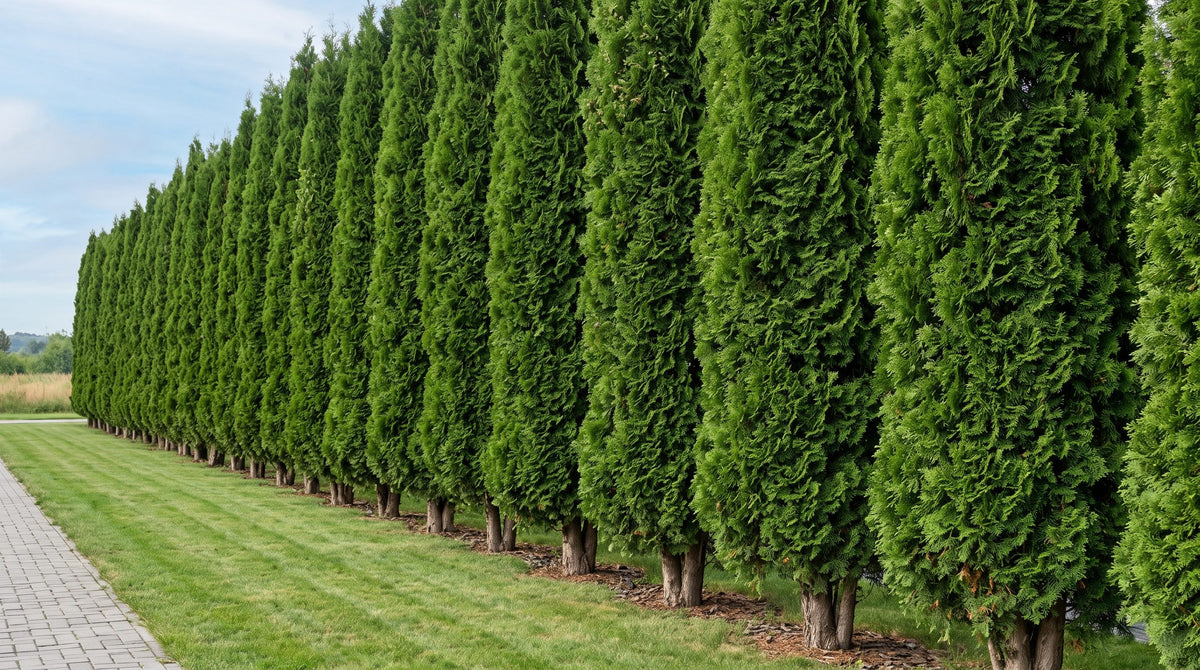
Plant Green Giant arborvitae when you have room and want height fast: it reaches 30 to 50 feet tall and 12 to 20 feet wide, adding 3 to 5 feet a year. Plant Emerald Green in narrow spaces: it stays 10 to 15 feet tall and 3 to 4 feet wide, grows slowly and holds its winter color.
Emerald Green vs Green Giant arborvitae is a choice between two dense evergreen walls that solve different problems. Green Giant is a large hybrid built for speed and scale. It suits long property lines, open acreage and views that need blocking at second-story height, and deer tend to leave it alone. Emerald Green is a narrow, tidy column. It fits a side yard, a short fence line or a bed beside the house, where a Green Giant would soon crowd the space. The choice comes down to four questions: how wide a strip you can give the row, how tall the screen must grow, whether deer visit, and how long the run is. That last one sets your plant count and your order. Below, we walk through each decision step by step, then give the spacing and the number of trees for runs of 50, 100, 200 and 500 feet, so you can order the right quantity the first time.
Plants for a privacy screen
1. Measure the width you can give
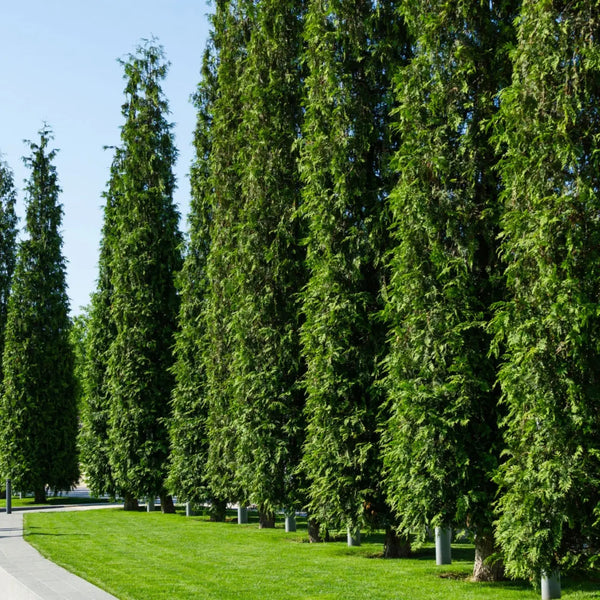
Start with width, not height. A mature Green Giant spreads 12 to 20 feet, so it needs open ground on both sides of the row, well clear of driveways, walls and the property line. Emerald Green stays 3 to 4 feet wide and fits a strip barely wider than a fence. If the strip is narrower than Green Giant's spread, it will need constant cutting back, and Emerald Green is the better fit.
Tip: We grow Green Giant, not Emerald Green; for narrow strips, see our compact boxwoods further down.
2. Decide how tall and how fast
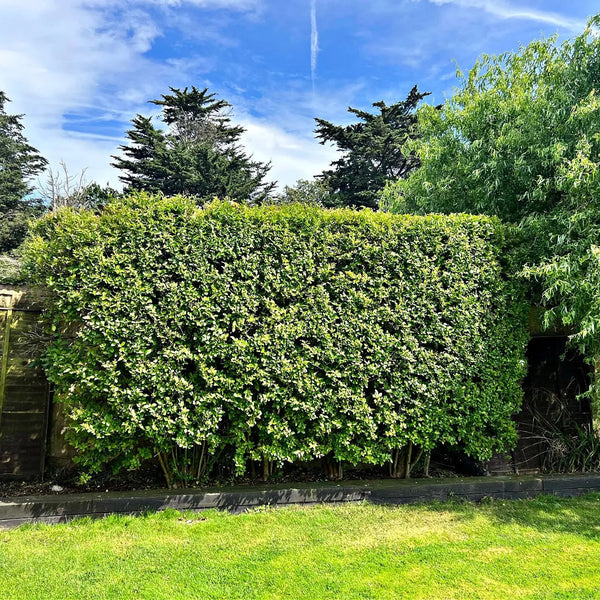
Green Giant reaches 30 to 50 feet or more and adds 3 to 5 feet a year once settled, so it screens a two-story house quickly. Emerald Green tops out around 10 to 15 feet and adds roughly 6 to 12 inches a year. For a fast sheared hedge in between, Northern Privet reaches 10 to 15 feet and California Privet grows quickly too.
Tip: Our Green Giant ships at 1 to 2 feet in packs of 25, 50, 100 and 500.
3. Set the spacing and count your trees
Measure spacing from trunk center to trunk center. Plant Green Giant 5 to 6 feet apart for a dense screen, or 6 to 8 feet if you can wait longer for the gaps to close. Plant Emerald Green 3 to 4 feet apart. To count trees, divide the run's length in feet by the spacing, round down, and add one for the end tree. The table at the end of this guide does the sums for common runs.
Tip: A 100-foot Green Giant row at 5 feet needs 21 trees, so one 25-pack covers it with spares.
4. Weigh deer pressure and winter color
Deer are the deciding factor in many rural and suburban yards. Green Giant has strong resistance to deer browsing, while Emerald Green is browsed often, and the damage shows plainly along a hedge. Winter color runs the other way: Emerald Green holds its bright green through the cold months, and Green Giant can bronze or fade a little in harsh winters.
Tip: In deer country, Green Giant is the safer long-term screen.
5. Plant well and water the first year
Give the row full sun; Green Giant will also handle light afternoon shade. Dig each hole about twice as wide as the root ball, set the tree at the depth it grew, and backfill with soil mixed with compost. Water deeply at planting, then keep the soil evenly moist, not soggy, through the first growing season and into fall. A layer of mulch over the root zone helps hold that moisture.
Smaller spaces and lower hedges
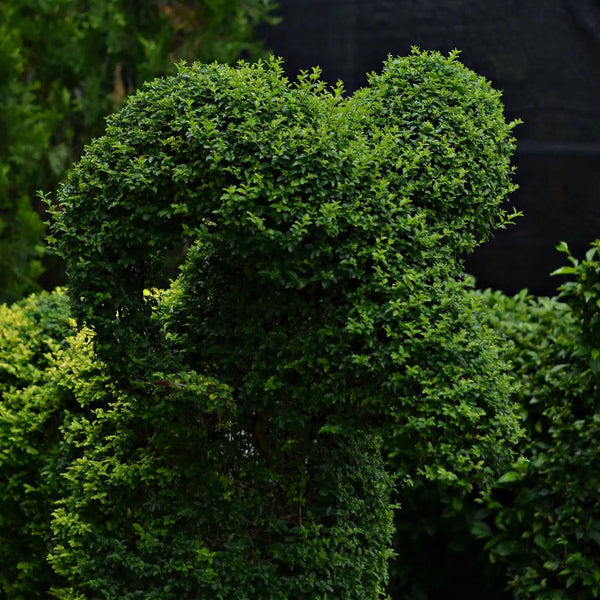
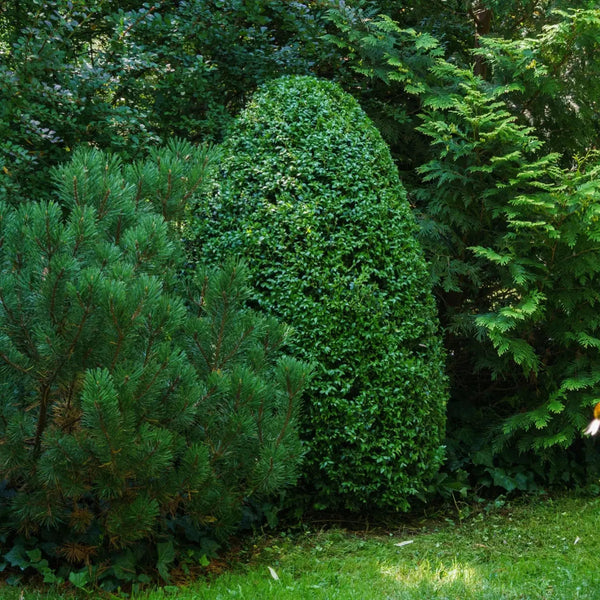
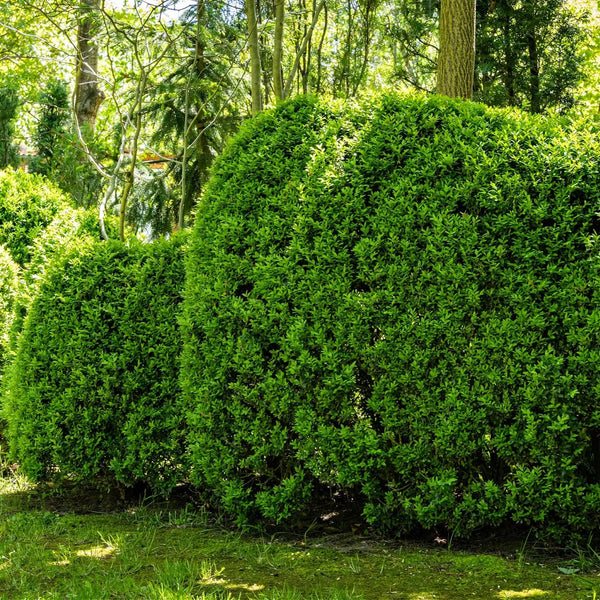
Emerald Green earns its place where space is the limit: a narrow side yard, a planting strip along a driveway, or a bed close to the house. Its slim column stays neat, and at 10 to 15 feet it screens eye-level views without shading out a small lot. Emerald Green is not in our catalog, so for tight spaces we suggest two evergreens that stay compact and take shearing well. Green Mountain Boxwood is a pyramidal shrub that grows to about 8 feet, handles cold winters and wind, and resists boxwood blight, which makes it a good choice for a formal screen along a foundation or patio. Wintergreen Boxwood is lower, reaching up to about 5 feet and nearly as wide, and suits edging, borders and short hedges that frame a space rather than hide it. Both grow in full sun or partial shade. For longer runs on a small lot, a privet hedge sheared narrow gives faster cover.
Care and keeping
Trim arborvitae lightly in late spring or early summer, taking only green tips; older bare wood rarely pushes new growth, so a hard cut can leave a lasting gap. Where deer visit, choose Green Giant for the main row, and shield any young Emerald Green with netting through its first winters.
Frequently asked questions
What are green giant trees?
Green Giant is a hybrid arborvitae, Thuja standishii x plicata, grown as a fast evergreen privacy tree. It has dense, dark green foliage, reaches 30 to 50 feet or more and 12 to 20 feet wide, tolerates ice and snow, and adapts to a wide range of soils. Most people plant it in rows as a living screen.
How fast do arborvitae trees grow?
It depends on the variety. Green Giant is among the fastest, adding 3 to 5 feet a year once its roots settle. Emerald Green is slow to moderate, adding about 6 to 12 inches a year, sometimes more in good conditions. Full sun and steady water in the early years help either one reach its pace.
Can I cut the top off emerald green arborvitae?
You can, but it is rarely worth it. Topping leaves a flat, open crown that takes time to fill, and arborvitae do not regrow well from bare wood. If 10 to 15 feet is too tall for the spot, a naturally shorter hedge plant is a better choice than cutting the top every year.
Emerald green vs green giant arborvitae at a glance
| Feature | Green Giant | Emerald Green |
|---|---|---|
| Mature height | 30 to 50+ ft | 10 to 15 ft |
| Mature width | 12 to 20 ft | 3 to 4 ft |
| Growth per year | 3 to 5 ft | 6 to 12 in |
| Hedge spacing | 5 to 6 ft (up to 8) | 3 to 4 ft |
| Deer resistance | High | Often browsed |
| Winter color | Can bronze in harsh cold | Holds bright green |
| Best for | Long lines, large lots | Narrow strips, small lots |
Green Giant
- Mature height
- 30 to 50+ ft
- Mature width
- 12 to 20 ft
- Growth per year
- 3 to 5 ft
- Hedge spacing
- 5 to 6 ft (up to 8)
- Deer resistance
- High
- Winter color
- Can bronze in harsh cold
- Best for
- Long lines, large lots
Emerald Green
- Mature height
- 10 to 15 ft
- Mature width
- 3 to 4 ft
- Growth per year
- 6 to 12 in
- Hedge spacing
- 3 to 4 ft
- Deer resistance
- Often browsed
- Winter color
- Holds bright green
- Best for
- Narrow strips, small lots
Trees needed per hedge length
| Row length | Green Giant at 5 ft | Green Giant at 6 ft | Green Giant at 8 ft | Emerald Green at 3 ft | Emerald Green at 4 ft |
|---|---|---|---|---|---|
| 50 ft | 11 | 9 | 7 | 17 | 13 |
| 100 ft | 21 | 17 | 13 | 34 | 26 |
| 200 ft | 41 | 34 | 26 | 67 | 51 |
| 500 ft | 101 | 84 | 63 | 167 | 126 |
Green Giant at 5 ft
- 50 ft
- 11
- 100 ft
- 21
- 200 ft
- 41
- 500 ft
- 101
Green Giant at 6 ft
- 50 ft
- 9
- 100 ft
- 17
- 200 ft
- 34
- 500 ft
- 84
Green Giant at 8 ft
- 50 ft
- 7
- 100 ft
- 13
- 200 ft
- 26
- 500 ft
- 63
Emerald Green at 3 ft
- 50 ft
- 17
- 100 ft
- 34
- 200 ft
- 67
- 500 ft
- 167
Emerald Green at 4 ft
- 50 ft
- 13
- 100 ft
- 26
- 200 ft
- 51
- 500 ft
- 126
Counts assume a single straight row with a tree at each end. Match the total to our packs of 25, 50, 100 or 500, with a few spares.