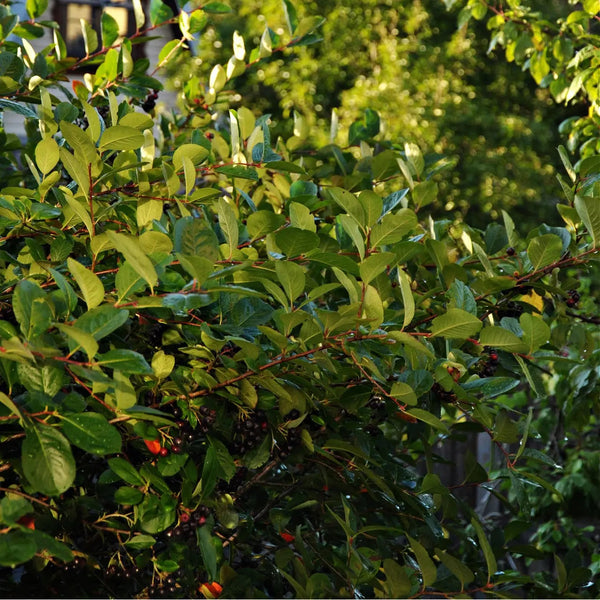
The short answer
Red chokeberry vs black chokeberry comes down to your site. Choose red (Aronia arbutifolia) for wet, boggy ground and slopes: it grows upright to 6–8 feet and holds red berries into winter. Choose black (Aronia melanocarpa) for colder zones, mixed soils and fruit: its larger black-purple berries ripen in late summer for jam.
Red chokeberry vs black chokeberry
| Feature | Red chokeberry | Black chokeberry |
|---|---|---|
| Size | 6–8 ft tall, 3–4 ft wide | 3–10 ft tall, 3–6 ft wide |
| Hardiness zones | 4 to 9 | 3 to 8 |
| Soil | Moist to boggy; tolerates clay or dry | Wet or dry, clay or sand |
| Berries | Scarlet, about 1/4 inch, last into winter | Black-purple, about 1/2 inch, August–September |
| Fall color | Scarlet, purple or orange | Red to burgundy |
| Best site | Wet ground, pond edges, slopes | Rain gardens, hedges, berry plantings |
Red chokeberry
- Size
- 6–8 ft tall, 3–4 ft wide
- Hardiness zones
- 4 to 9
- Soil
- Moist to boggy; tolerates clay or dry
- Berries
- Scarlet, about 1/4 inch, last into winter
- Fall color
- Scarlet, purple or orange
- Best site
- Wet ground, pond edges, slopes
Black chokeberry
- Size
- 3–10 ft tall, 3–6 ft wide
- Hardiness zones
- 3 to 8
- Soil
- Wet or dry, clay or sand
- Berries
- Black-purple, about 1/2 inch, August–September
- Fall color
- Red to burgundy
- Best site
- Rain gardens, hedges, berry plantings
Choose red chokeberry if
- Your site stays wet or boggy, such as a pond edge or a soggy low corner.
- You want bright red berries that stay on the branches and feed birds in late winter.
- You need a narrow, upright shrub or one to help hold soil on an embankment.
Choose black chokeberry if
- You plant in the coldest northern sites, down to zone 3.
- You want larger berries to cook into jam or jelly in late summer.
- Your soil swings from wet to dry, clay to sand, or acid to alkaline.
Berries and their uses
Berry color is the quickest way to tell the two apart. Red chokeberry carries clusters of scarlet berries, each about a quarter inch across. They stay on the branches through winter, so the shrub keeps its color long after the leaves drop. Birds come for them in late winter, when other food is scarce. Black chokeberry berries are glossy black-purple and about half an inch across, roughly twice the size. They ripen in August and September. The fruit is edible but very tart and dry on the tongue, so most people cook it into jam or jelly. The University of Minnesota notes it is also used for juice, wine and tea. If you plan to harvest, plant black chokeberry in full sun and net a few shrubs, because birds take their share. For a planting meant only to feed wildlife through winter, red chokeberry earns its place.
Soil, water and zones
Both shrubs are native and tough, but they lean different ways. Red chokeberry is the wet-ground specialist. It grows wild in swampy spots and handles boggy soil, so it suits pond borders, water features and other soggy corners. It also helps hold soil on embankments, and it shrugs off salt and pollution, which makes it useful along roads. It is rated for zones 4 to 9 and does best in full sun, though it takes part shade. Black chokeberry is the all-rounder. It copes with wet or dry soil, clay or sand, and acid or alkaline ground. Its range runs from zone 3 to zone 8, so it is the safer pick for the coldest northern sites. Full sun gives the most berries. In the hottest zone 9 sites, red chokeberry is the one rated to grow.
Our verdict
Pick red chokeberry for wet ground, pond edges and slopes, or where winter berries for birds matter most. Pick black chokeberry for the coldest sites, mixed or changing soils, and any planting where you want berries to cook. On a large site, plant both.
Frequently asked questions
- Is chokeberry the same as chokecherry?
No. Chokeberry is aronia, a native shrub with clusters of small berries, each holding several tiny seeds. Chokecherry is a different plant, Prunus virginiana, a wild cherry whose fruit hangs in long, drooping strands with one hard pit in each. The names sound alike, so check the botanical name before you buy.
- How tall do black chokeberry bushes get?
Our black chokeberry stock is listed at 3 to 10 feet tall and 3 to 6 feet wide. The University of Minnesota gives a typical mature height of 4 to 8 feet. Most stay lower and wider than red chokeberry, which grows more upright to 6 to 8 feet. Suckers slowly widen the clump over time.
Spacing and bulk planting counts
Both shrubs ship in 1-2, 2-3 and 3-4 foot sizes, in packs of 25, 50, 100 and 500. For a black chokeberry hedge, set plants 3 to 4 feet apart. Red chokeberry grows 3 to 4 feet wide, so the same spacing closes a row.
- At 4 feet apart, 25 plants make a hedge about 100 feet long.
- At 4 feet apart, 100 plants run about 400 feet.
- At 3 feet apart, the same 100 plants cover about 300 feet and fill in sooner.
- The 1-2 foot size is the easiest to plant at scale. The 3-4 foot size looks fuller sooner.
Native shrubs to plant with chokeberry
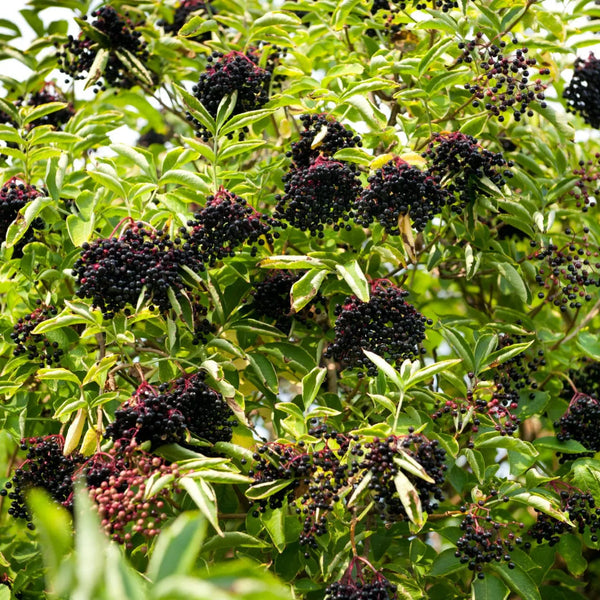
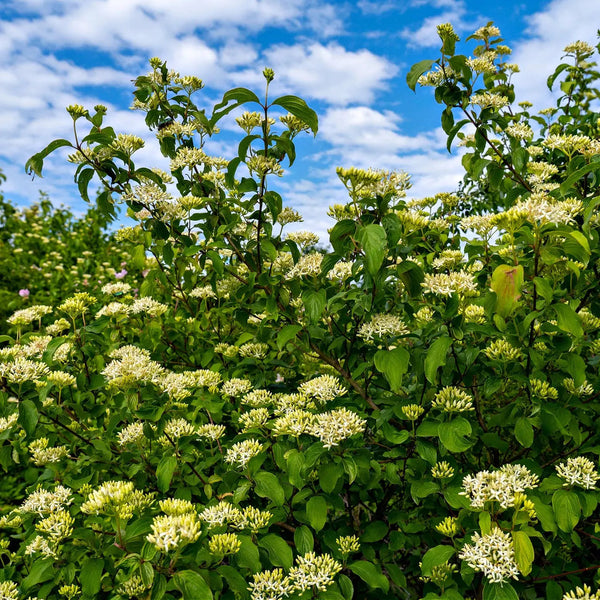
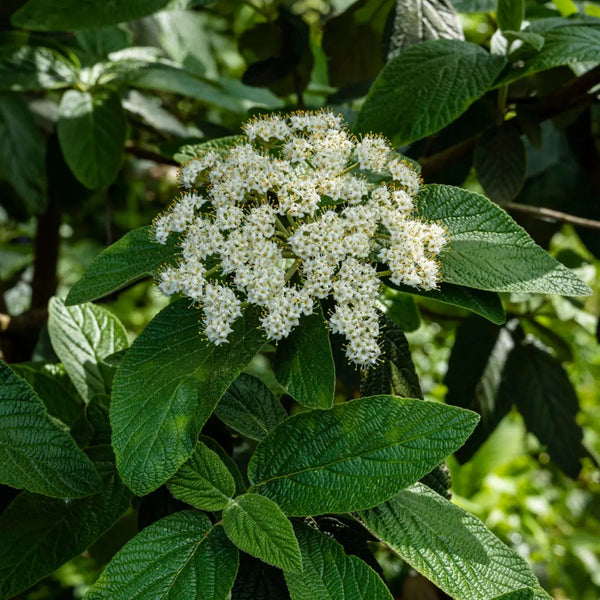
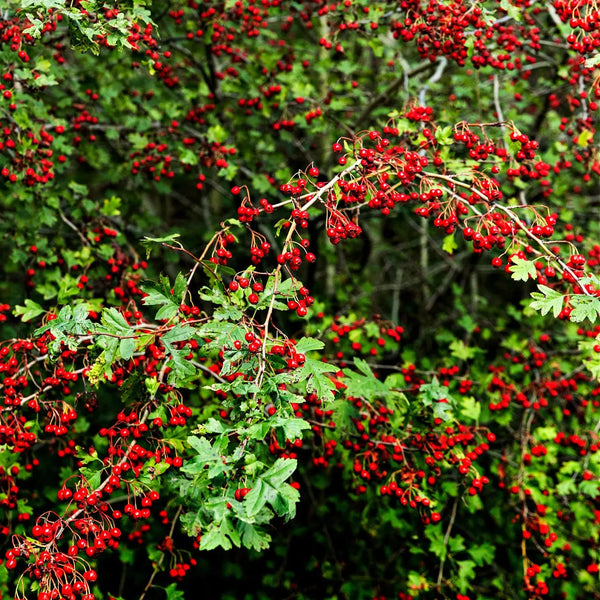
For a mixed hedgerow or wildlife strip, pair chokeberry with other native berry shrubs. Elderberry likes the same moist ground and grows 5 to 12 feet tall. Black haw viburnum handles dry, rocky spots and reaches 12 to 15 feet. Arrowwood viburnum (Viburnum dentatum) adapts to most soils and makes a high hedge or screen. See the full range in our shrubs collection.