
The short answer
Dogwood tree identification starts with the leaves: opposite pairs, veins curving toward the tip, and fine white threads when you tear one. Then check bark and bloom. Native flowering dogwood has blocky bark and notched bracts. Kousa has mottled, peeling bark and blooms a month later. Shrub dogwoods grow as red-stemmed clumps with flat flower clusters.
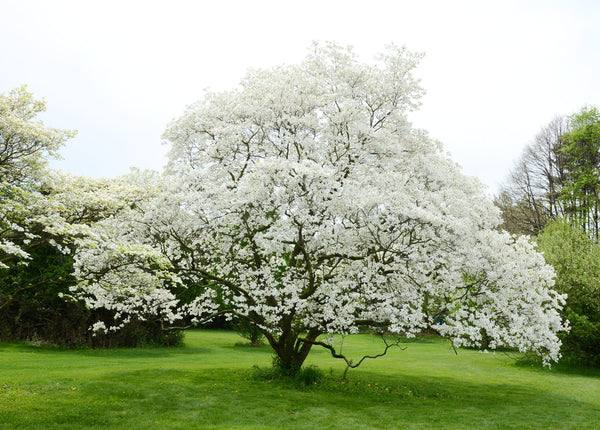
Dogwoods are easy to love and surprisingly easy to mix up. The native flowering dogwood (Cornus florida), the Asian kousa dogwood (Cornus kousa) and a handful of shrub dogwoods all share the same family traits. Yet they bloom at different times, carry different fruit and fit very different sites. That matters when you are checking an existing tree before a project, or making sure the stock you plant is the species on the plan. This guide walks through the clues in the order you can see them: leaves, bark, bracts, fruit, and the winter buds that still give a dogwood away when nothing is in flower. Then it sets tree dogwoods beside shrub dogwoods, and ends with a side-by-side table of flowering dogwood and kousa. If you are planting the native species, our White Dogwood Tree is Cornus florida, shipped bare-root for yards, woodland edges and larger orders. Songbirds, quail and wild turkey eat its fruit.
Dogwood tree identification, step by step
1. Check the leaves and do the string test
Dogwood leaves are simple ovals that grow in opposite pairs along the twig. The side veins curve upward and follow the edge of the leaf toward the tip. For the string test, hold a leaf at both ends and tear it slowly across the veins. Fine white threads stretch between the two halves. Pagoda dogwood is the main exception, with leaves that alternate along the stem.
Tip: The string test works on most dogwoods, so use it to confirm the family, not the species.
2. Read the bark on the trunk
On a mature flowering dogwood, the bark breaks into small, scaly gray-brown blocks. Many people compare it to alligator skin. Kousa dogwood looks different. Its bark starts smooth and light brown, then ages into mottled patches of tan and brown as it peels. Shrub dogwoods such as red osier skip the single trunk. They grow as clumps of slim stems, and the young stems show bright red in winter.
Tip: Bark is the most useful clue on a large tree whose leaves are out of reach.
3. Look at the bracts and true flowers
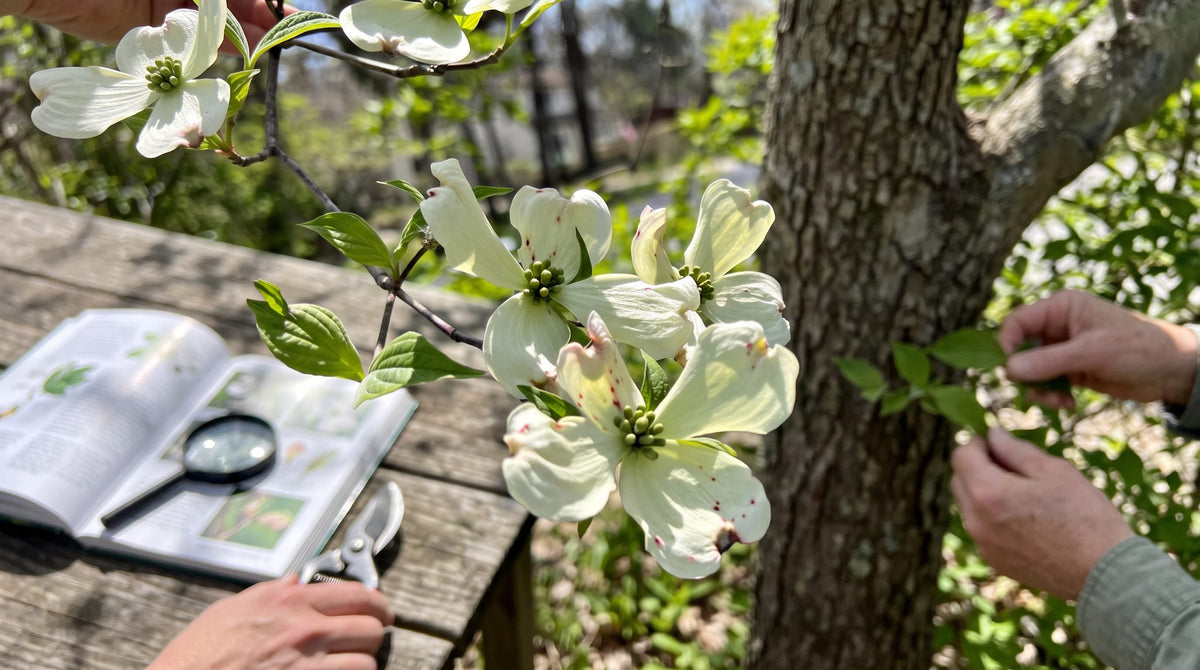
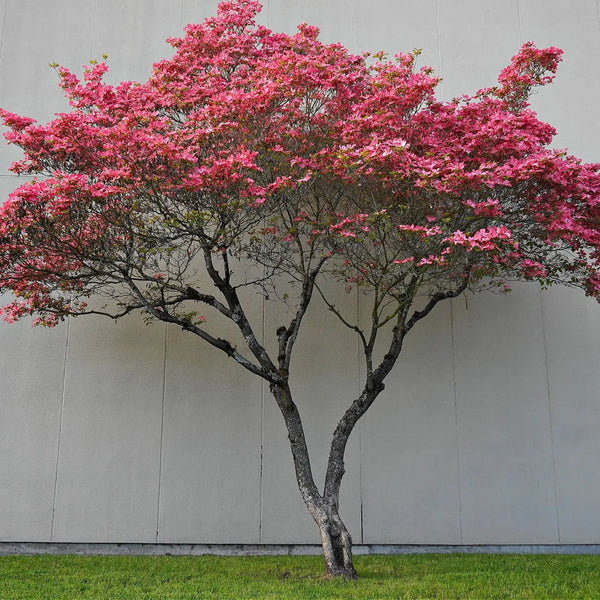
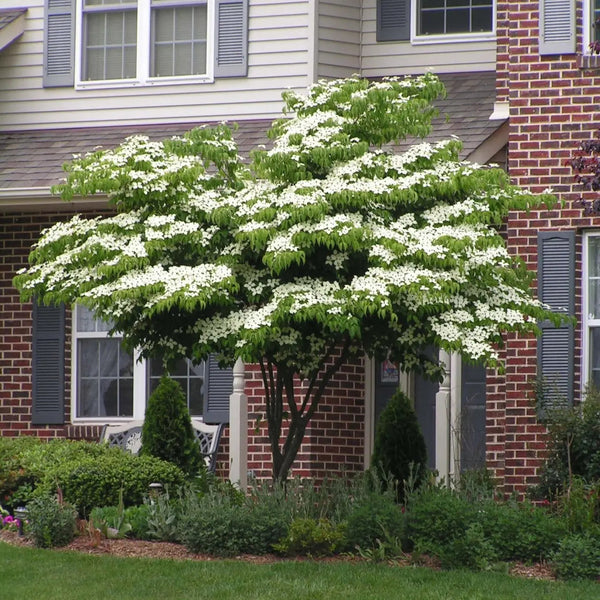
What look like four petals are bracts, special leaves that frame the real flowers. The true flowers are tiny, greenish yellow and packed into a button in the center. Flowering dogwood bracts have a small notch at each tip. They open from about March to May, before the leaves. Kousa blooms about a month later, in late spring, and its bracts can almost cover the tree. Our Pink Dogwood Tree is a pink-flowering Cornus florida.
Tip: Flowering dogwood bracts come in white or pink, so color alone does not tell you the species.
4. Match the fruit to the species
Fruit is the easiest clue from late summer into fall. Flowering dogwood carries glossy red fruits in small clusters, ripening from about August to October. Kousa fruit is round, red to pink and 1 to 1.5 inches across, much larger than the native tree's. Shrub dogwoods carry white or blue-white berries in flat clusters. Red osier berries are white, and silky dogwood berries run blue to white.
Tip: Fallen fruit on the ground under the tree counts as a clue too.
5. Identify a dogwood tree out of bloom
In winter, look at the twig tips. Flowering dogwood holds round flower buds shaped like small onions at the ends of its branches. The leaf buds, scars and side twigs all sit in opposite pairs. Branch ends are green to slightly purple. A young tree has one trunk; a shrub is a clump of stems. Red osier stems turn bright to dark blood red, and silky dogwood twigs are dark reddish.
Tip: Kousa bark stays mottled all year, which makes it easy to spot in winter.
Tree dogwoods vs shrub dogwoods
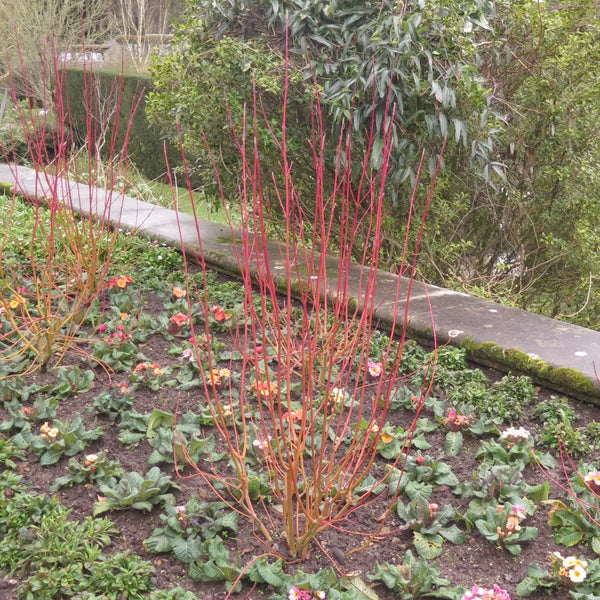
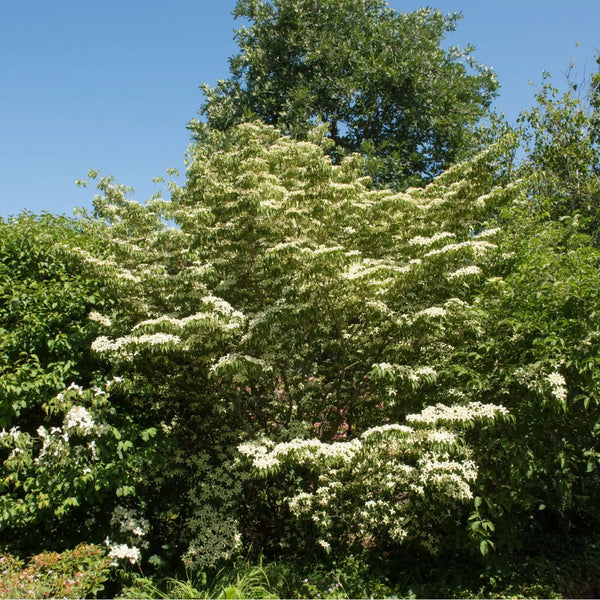
Not every dogwood grows into a tree. Flowering dogwood and kousa usually form a single trunk with a wide crown. Flowering dogwood reaches about 15 to 25 feet tall and up to 30 feet across. Kousa tops out at 20 to 30 feet, with a spread of 15 to 30 feet. Shrub dogwoods stay lower and grow as clumps of many stems. Red osier dogwood, also sold as red twig dogwood, reaches 5 to 13 feet high and 10 to 16 feet wide. It spreads by underground stems, so one plant becomes a thicket. Silky dogwood reaches 6 to 8 feet and loves wet soil along ponds and streams. Both shrubs carry flat clusters of small flowers rather than four big bracts. Both have red stems that stand out in winter. If you see a many-stemmed clump by water with red twigs and pale berries, you are looking at a shrub dogwood, not a young tree.
Care and keeping
Where you plant matters as much as which dogwood you pick. Flowering dogwood wants loose, slightly acidic soil rich in organic matter, and it dislikes wet ground. In warm areas, give it shade by mid-afternoon; farther north, full sun is fine. Kousa takes full sun or morning sun with afternoon shade.
Frequently asked questions
What's the difference between a Kousa Dogwood and a regular dogwood?
The regular, or native, flowering dogwood (Cornus florida) blooms from about March to May, before its leaves. It has notched bracts, blocky bark and small red fruits in clusters. Kousa (Cornus kousa) comes from Asia, blooms about a month later, has mottled peeling bark and carries larger round fruit. It also resists anthracnose, a serious dogwood disease, better.
What do dogwood tree blossoms look like?
Each blossom looks like a flat flower with four broad petals, but those are bracts. On flowering dogwood they are white, pink or red, about 2 inches long, with a notch at the tip. The true flowers are about 20 tiny greenish-yellow blooms clustered in a small head in the center.
What is the best location to plant a dogwood tree?
Pick a spot with loose, well-drained soil that runs slightly acidic, and avoid the low corner where water stands. In warm areas and near the coast, flowering dogwood does best with shade by mid-afternoon, such as the east side of a house. Farther north, full sun is fine. Fence young trees where deer browse.
Flowering dogwood vs kousa dogwood at a glance
| Feature | Flowering dogwood (Cornus florida) | Kousa dogwood (Cornus kousa) |
|---|---|---|
| Origin | Native | Asia |
| Bloom time | About March to May, before the leaves | Late spring, about a month later |
| Bracts | White, pink or red, notched at the tip | White, 2 to 3 inches long |
| Bark | Small scaly gray-brown blocks | Smooth when young, then mottled tan and brown |
| Fruit | Glossy red, in small clusters, August to October | Round, red to pink, 1 to 1.5 inches, late summer into fall |
| Size | 15 to 25 feet tall, up to 30 feet wide | 20 to 30 feet tall, 15 to 30 feet wide |
| Zones | 5 to 9 | 5 to 8 |
| Sun | Shade by mid-afternoon in warm areas; full sun farther north | Full sun, or morning sun with afternoon shade |
| Anthracnose | More likely to suffer | Stands up better |
Flowering dogwood (Cornus florida)
- Origin
- Native
- Bloom time
- About March to May, before the leaves
- Bracts
- White, pink or red, notched at the tip
- Bark
- Small scaly gray-brown blocks
- Fruit
- Glossy red, in small clusters, August to October
- Size
- 15 to 25 feet tall, up to 30 feet wide
- Zones
- 5 to 9
- Sun
- Shade by mid-afternoon in warm areas; full sun farther north
- Anthracnose
- More likely to suffer
Kousa dogwood (Cornus kousa)
- Origin
- Asia
- Bloom time
- Late spring, about a month later
- Bracts
- White, 2 to 3 inches long
- Bark
- Smooth when young, then mottled tan and brown
- Fruit
- Round, red to pink, 1 to 1.5 inches, late summer into fall
- Size
- 20 to 30 feet tall, 15 to 30 feet wide
- Zones
- 5 to 8
- Sun
- Full sun, or morning sun with afternoon shade
- Anthracnose
- Stands up better